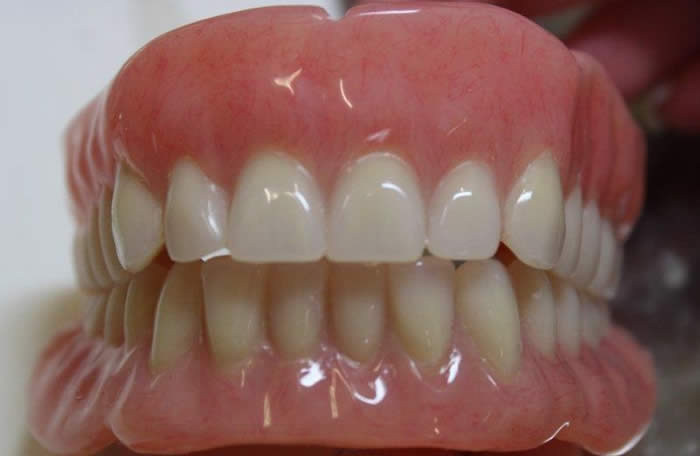
Your new Dentures
A few handy hints that will help you understand your new dentures
Your Denture
Dentures are an artificial appliance and you wil need time to adapt to them because wearing dentures is a learned process, not an instinct with which we are born.
Your tolerance, adaption, function and patience will be made much easier when you understand that any denture, no matter how well designed and constructed by your DP, is at best a substitute for no teeth, not a substitute for natural teeth.
Dentures are designed to last for 5 to 10 years and just as with natural teeth, must be regularly serviced and maintained in order to achieve that lifespan.
Perseverance
The keyword to success with your new denture is “PERSEVERANCE”. Your DP will never expect you to tolerate pain or soreness, but it is important to leave your new denture in your mouth as long as you can for the first few days and not take it out for any reason other than it is causing pain or soreness, or that it requires cleaning. The first 48 hours are generally the most challenging and frequently determine your success with your new denture.
Read out Loud
Speech is frequently affected by new dentures, but is also one of the easiest problems to resolve. Simply reading out loud, or singing if you enjoy, will allow your tongue to find the correct position for enunciating your speech. If you find any speech impediment, simply slow down as you talk or sing and you will soon find a more comfortable pace that adapts to your new denture.
Denture Adhesive
No denture, no matter how well made by your DP, will ever, have the retention and stability of natural healthy teeth. For that reason, it is frequently necessary to use an adhesive to provide that little bit of extra retention.
Denture adhesives will never make a poorly fitting denture good, but will frequently make a well fitting denture better. If the only way you can keep your denture in your mouth is by the use of adhesives, then you almost certainly need either a new denture or a reline and should consult your DP.
The continued use of vast amounts of adhesive would very quickly cost the same as proper denture maintenance or replacement, so is clearly a poor choice.
Suction with your new denture
It is reasonable to expect that suction may take time with your new denture. Your upper denture needs time to adapt to the palate, lips, and cheeks and the denture needs to seat into the soft tissue at the back of the palate. This process can take anywhere from 1 hour to 24 hours depending upon the amount of soft tissue.
The lower denture relies on the action of your tongue and cheeks working together to hold it in place. It is very important to understand that a full lower denture will never have the suction that an upper denture can provide. With patience and perseverance from you and with the support of your DP to relieve any pressure areas you will soon adapt to your new dentures. Teamwork between you and you DP, you will find success with your dentures.
During early stages of adapting to your new dentures, it can be very helpful to drink more water in order to maintain moisture levels in your mouth or to remove any excess saliva that sometimes occurs. Many people have also found that sucking on a hard sugar free mint or drinking through a straw can help the suction of new denture to become stronger.
Should dentures be left out at night?
Personal choice always rules in an answer to this question. Most people only ever remove their dentures for cleaning, which must be done properly at least twice a day. Others remove their dentures and leave them by their bedside overnight in a glass of water.
There is no definitive evidence that dentures should be left out for an extended period of time, but those who do promote leaving out will say that the supporting tissues needs adequate massage and cleaning to ensure proper health.
On the other hand, simply eating with your dentures massages the gums whilst the natural anti bacterial benefits of saliva will counteract some of the other bacteria that may occur with wearing dentures. Brushing your gums and tongue with a soft toothbrush everyday will assist the general health of the supporting tissue and brushing gums and tongue is equally important even if you still have remaining teeth.
How long do dentures last?
As with most things we have, how long it lasts depends upon how well we look after it. Just as we need to service our natural teeth with regular checkups, we also need to check our mouths and dentures for wear and fit every year.
For the small costs of a consultation fee, you DP can provide you with detailed assessment of the condition of your dentures and the cost of any recommended services.
With proper care maintenance, it is reasonable to expect your denture to last between 5 to 8 years , but only if you have had regular checkups and relines as required.
Dry mouth No denture, no matter how well made by your DP, will ever have the retention and stability of natural teeth. For that reason, it is frequently necessary to use an adhesive to provide that little bit of extra retention.